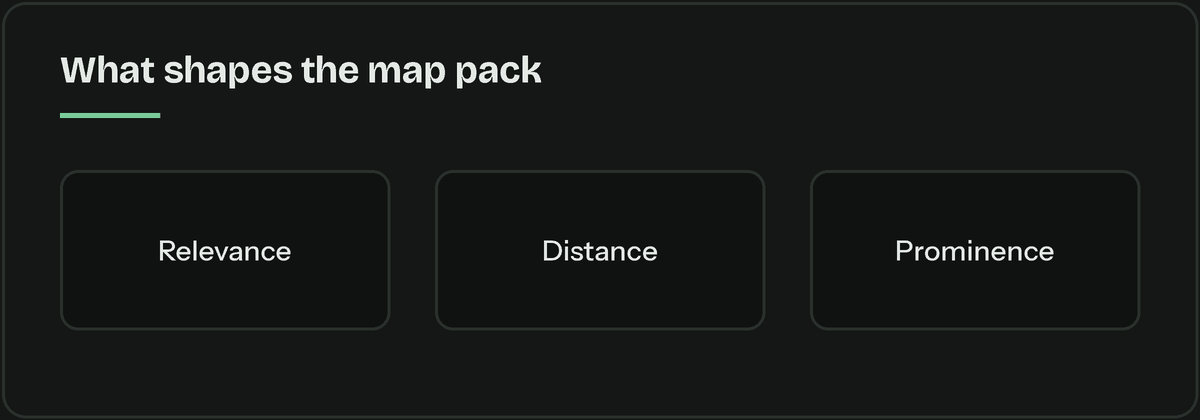
Short answer: Google decides which businesses appear in the map pack using three main factors: relevance, meaning how well your profile matches the search; distance, meaning how close you are to the searcher or the place they named; and prominence, meaning how well known and trusted your business appears based on reviews, links, mentions and your website. You cannot control distance, but you can strongly influence relevance and prominence.
When someone in Spokane searches for a roofer, a dentist or an emergency plumber, Google often shows a map with a short list of businesses near the top of the results. That group is commonly called the map pack or local pack. For many service businesses it is the most valuable spot in search, because it appears above most other results and includes your phone number, reviews and directions.
Google has been fairly open about the main factors it uses. This guide explains each one in plain language and what a local business can actually do about it.
Relevance: does your business match the search?
Relevance is about how well your Google Business Profile and website match what the person searched for. Google looks at the details you provide and the content it finds.
Ways to improve relevance
- Choose the right primary category. Your primary category is one of the strongest relevance signals. Pick the category that best describes your main service.
- Add accurate secondary categories. Use them for other services you genuinely offer.
- Fill in services and descriptions. List your services on your profile with clear names that match how customers search.
- Build strong service pages. Your website should have a dedicated page for each core service, linked from your profile where appropriate.
- Keep information complete. Hours, attributes, service areas and photos all help Google understand your business.
Our guide to Google Business Profile optimization covers these settings in detail.
Distance: how close are you?
Distance is how far your business is from the location of the search. If someone searches for a service and names a place, such as a neighborhood in Spokane Valley, Google uses that place. If they do not name one, Google uses what it knows about the searcher’s location.
What you can and cannot do
You cannot change where your customers are standing, and you should not create fake addresses to appear closer. Doing so violates Google’s guidelines and can lead to suspension. What you can do is make sure your address or service areas are set correctly, and build genuinely local content and links in the areas you serve so you are a strong candidate when distance is close.
Service area businesses
If you travel to customers, your profile can list service areas instead of showing an address. Service areas describe where you work, but rankings still tend to be strongest near your verified location.
Prominence: how well known are you?
Prominence is Google’s sense of how established and trusted a business is. It draws on information from across the web.
Signals that build prominence
- Reviews. The number, quality and recency of reviews, plus your replies. Our guide on how to get more Google reviews covers honest ways to earn them.
- Links and mentions. Links from local organizations, news sites, suppliers and associations, plus mentions of your business name.
- Citations. Consistent listings on directories and data providers.
- Your website’s overall strength. Organic search performance and site quality contribute to how prominent your business appears.
- Real world reputation. Well known businesses and landmarks tend to rank well because Google reflects their fame.
What does not help
- Keyword stuffing your business name. Adding services or cities to your name breaks Google’s guidelines and risks suspension.
- Fake reviews. Buying or trading reviews can lead to removed reviews or penalties.
- Fake locations. Virtual offices and mailboxes used only to rank in other areas violate the rules.
- Constant small edits. Repeatedly changing your profile does not improve rankings and can trigger reviews by Google.
Why rankings vary from search to search
Many business owners check their ranking from their office and see a different result than a customer across town. That is normal. Because distance matters, the map pack changes depending on where the searcher is and exactly what they type. A fair picture of your visibility comes from checking several searches from several points across your service area.
A practical plan
- Confirm your primary category and add accurate secondary categories.
- Complete every relevant section of your profile.
- Build or improve a dedicated website page for each core service.
- Ask every happy customer for a review and reply to every review.
- Clean up your citations so details match everywhere.
- Earn genuine local links through community involvement and partnerships.
If you want a team to handle this work, our local SEO services focus on the factors that move map visibility for service businesses.
Frequently asked questions
Can we pay to appear in the map pack?
Google offers ads that can appear in or near map results, such as Local Services Ads and local search ads. The organic map pack itself cannot be bought.
Why does a competitor with fewer reviews rank above us?
Reviews are only one part of prominence. The competitor might be closer to the searcher, have a better matched category or stronger website signals.
How long does it take to improve map rankings?
It varies widely. Fixing categories and profile details can help relatively quickly, while building reviews, links and content takes steady work over months.
Next step
Curious how your business shows up in the map pack across your service area? Request a free audit and we will show you where you appear and what to work on.
Work with a local team: Spokane SEO, Spokane Valley SEO and a free SEO audit from an SEO company in Spokane.