
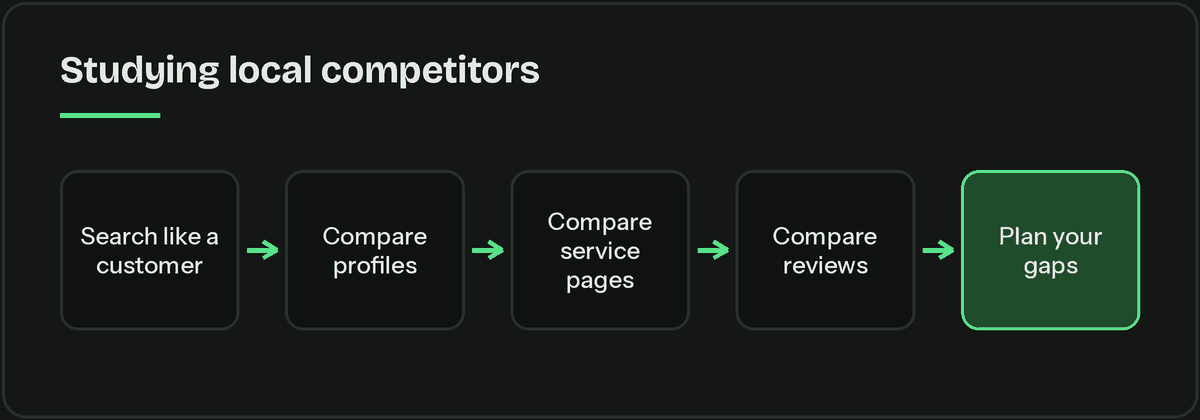
Short answer: To research local competitors in search, list the searches your customers use, check who appears in the map pack and the regular results for each from a few locations across your service area, then compare those businesses on profile completeness, reviews, website content and local links. The goal is not to copy them but to find the gaps where your business can offer something more useful.
Every local business has competitors in search, and they are not always the businesses you think of as rivals. The company that shows up above you for drain cleaning in Spokane Valley might be one you have never met, while the competitor you worry about might barely appear online. Knowing who you actually compete with in search tells you what you are up against and where to focus your effort.
This guide shows a simple, free way to research local competitors.
Step one: list the searches that matter
Start with the searches real customers use to find businesses like yours. Write down your main services in plain words, then add variations.
- The service plus your city, such as furnace repair Spokane.
- The service plus near me.
- The service plus nearby communities you serve.
- Problem based searches, such as no heat in house or water heater leaking.
- Questions customers ask before hiring, such as how much does a roof replacement cost.
Google Search Console shows the searches your site already appears for, which is a helpful place to find more ideas. Our guide to keyword research for local businesses goes deeper.
Step two: see who appears
For each search, note the businesses that appear in the map pack and the top regular results. Because map results depend on the searcher’s location, check from more than one place. A simple way is to search while at different parts of your service area, or ask staff who live in different neighborhoods to send screenshots.
Use a private browser window so past browsing has less influence on what you see.
Sort what you find
You will usually see three kinds of results.
- Direct competitors: local businesses offering the same services.
- Directories and aggregators: sites like review platforms and lead generation services.
- Informational pages: articles and guides, often for question based searches.
Focus your detailed research on the direct competitors that appear most often.
Step three: compare Google profiles
For each main competitor, look at their Google Business Profile.
- What primary category do they appear to use?
- How many reviews do they have, how recent are they and do they reply?
- How complete is the profile, including services, photos and description?
- What do customers praise or complain about in reviews?
Review content is valuable. Complaints about competitors, such as slow responses or unclear pricing, point to strengths you can highlight honestly.
Step four: compare websites
Visit each competitor’s website and look at it as a customer would.
- Do they have a dedicated page for each service?
- How much useful detail do those pages include?
- Do they have pages for the areas they serve?
- Is the site fast and easy to use on a phone?
- Do they answer common questions and explain their process?
- What kind of blog or guide content do they publish?
Note what they do well and what is missing. You are looking for gaps, such as a service nobody explains clearly or a community nobody covers with real local detail.
Step five: look at local signals
Look at where competitors are mentioned around the web. Search their business name to find directory listings, local news mentions, sponsorships and associations. These are signs of prominence and can suggest opportunities for your own business, such as local organizations you could genuinely support.
Turning research into a plan
Once you have notes, compare them with your own presence honestly. Common findings include the following.
- Competitors have many more recent reviews, so a consistent review routine becomes a priority.
- Nobody has a strong page for a particular service, so building one is an opportunity.
- Competitors have more complete profiles, so filling in your services, photos and description comes first.
- Competitors are listed in local directories you are missing.
Prioritize the gaps that matter most to your customers and that you can realistically close.
What not to do
- Do not copy competitors’ content. Search engines and customers value original, useful pages.
- Do not obsess over every ranking change. Results vary by location and time.
- Do not use spam tactics because a competitor appears to get away with them.
Our guide on how to choose an SEO agency covers what good competitive research looks like if you hire help. Our local SEO services include a full competitor review as part of every engagement.
Frequently asked questions
How often should we check on competitors?
A thorough review once or twice a year is usually enough, with quick checks when you notice a change in calls or rankings.
Do we need paid tools for competitor research?
No. Searching manually from different locations and reviewing profiles and websites covers the essentials. Paid tools add convenience and more data.
What if a competitor is using spam to rank?
Report clear guideline violations through Google’s official tools, and keep focusing on strengthening your own profile and website.
Next step
Want a clear picture of who you compete with in local search? Request a free audit and we will compare your presence with the businesses that appear for your key services.
Work with a local team: Spokane SEO, Spokane Valley SEO and a free SEO audit from an SEO company in Spokane.