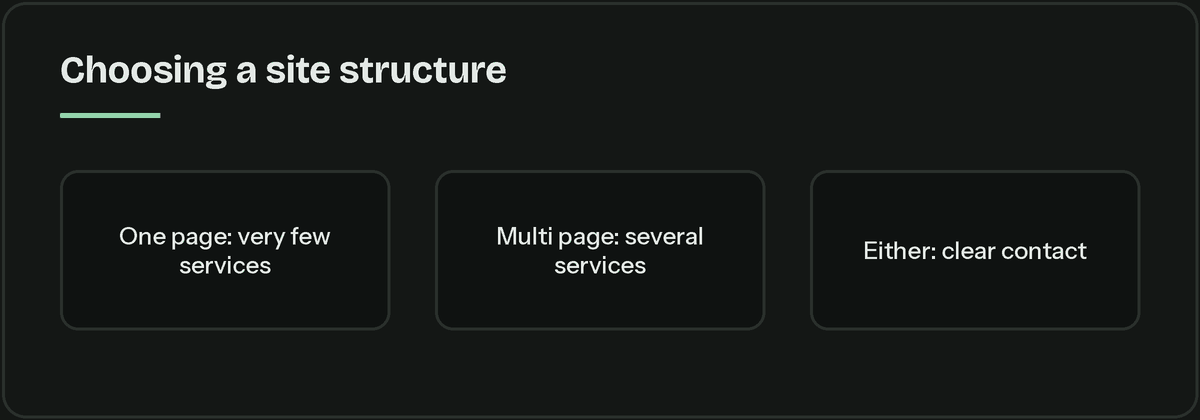
Short answer: A one page website can be enough for a very small business with one service and a tiny local area, or as a short term starting point. For most service businesses, a multi page website works better, because each service and main area can have its own page that answers specific questions and matches specific searches. A simple multi page site with a homepage, a page per core service, an about page and a contact page is often the right balance.
One page websites are popular for good reasons. They are quick to build, inexpensive, easy to maintain and can look clean and modern, with sections that scroll smoothly from introduction to services to contact. For some businesses, that is all they need. For many service businesses, though, a single page quietly limits how often they show up in search and how well they answer customer questions.
This guide explains the tradeoffs and how to decide.
How a one page website works
A one page site puts all content on a single long page, divided into sections. Navigation links usually jump to sections on the same page, such as services, about and contact. Everything a visitor needs is in one place.
Advantages of a one page site
- Quick to launch. Fewer pages means less to write and design.
- Simple to maintain. Changes happen in one place.
- Clear story. Visitors scroll through a guided path from introduction to contact.
- Low cost. Usually less expensive to build.
Limitations of a one page site
Fewer chances to match searches
Search engines rank pages, not websites. A single page has to cover everything, so it cannot focus on any one service or area. A business offering several services has a much harder time ranking for each one.
Less room to answer questions
Each service deserves an explanation of what it includes, how it works, what affects the price and common questions. Fitting all of that for several services onto one page makes it long and hard to scan.
Harder to target areas
If you serve several communities, a single page cannot provide genuinely local information for each.
Limited content for ChatGPT and Google answers
answer tools and search features often pull answers from focused pages with clear headings. A single page covering many topics gives them less to work with.
Weaker analytics
With everything on one page, it is harder to see which services interest visitors most.
When a one page site makes sense
- You offer one service in a small area.
- You need a presence quickly while a fuller site is planned.
- The site supports a business that gets most customers through referrals rather than search.
- You are running a temporary campaign or event page.
When a multi page site is the better choice
- You offer more than one core service.
- You serve several cities or neighborhoods.
- You want to show up in search for specific services.
- You want to answer customer questions in depth.
- You plan to add content, such as guides or project write ups, over time.
A simple multi page structure
A multi page site does not need to be large. A practical starting structure for a service business looks like this.
- Homepage: what you do, where you work and how to contact you, with links to each service.
- One page per core service: detailed, focused and helpful.
- About page: the real people behind the business.
- Contact page: phone, form, hours and service areas.
- Optional area pages: for the main communities you serve, with genuine local detail.
- Optional blog or resources: for guides and answers to common questions.
This structure gives each service its own chance to rank while keeping the site manageable. Our guide to web design for service businesses covers what each page should include.
Moving from one page to multi page
If you already have a one page site, you do not need to start over. Turn each service section into its own page with more detail, keep the homepage as an overview with links to each service and set up redirects if any addresses change. Keep the design consistent so the site still feels familiar to returning visitors.
What your customers expect
Think about how your customers search and decide. A homeowner looking for a specific repair often wants a page about that exact repair, with details, photos and answers. If they land on a long page covering everything you do, they have to hunt for the relevant section, and many will not bother. A focused page meets them where they are and makes the next step obvious.
Cost and effort
A multi page site takes more writing and design time, but the extra pages are often similar in layout, which keeps costs reasonable. The investment usually pays off through more search visibility and better informed leads. Our website development services include simple multi page builds designed to grow over time.
Frequently asked questions
Can a one page website rank on Google?
Yes, especially for the business name and a single main service. It is much harder for a one page site to rank for several different services or areas.
How many pages does a small service business need?
Enough to give each core service its own page, plus a homepage, about page and contact page. Many small businesses start with somewhere between five and ten pages.
Is a one page site faster?
Not necessarily. A long page with many images can be slow. Speed depends on how the page is built, not the number of pages on the site.
Next step
Not sure whether your current site structure is holding you back? Request a free audit and we will review your pages and suggest a structure that fits your services.
Work with a local team: Spokane SEO, Spokane Valley SEO and a free SEO audit from an SEO company in Spokane.