Short answer: A service page that ranks and converts opens with a clear headline naming the service and area, followed by a short summary and an obvious way to call or request a quote. It then explains what the service includes, signs a customer needs it, how the process works, what affects the price, where you offer it and why customers choose you, backed by real photos and genuine reviews. It finishes with answers to common questions and a final call to action.
Service pages are the workhorses of a local business website. When someone searches for water heater installation in Spokane or roof repair in Spokane Valley, the page Google is most likely to show is a dedicated service page, not your homepage. And when that visitor lands, the service page is what convinces them to call you instead of hitting the back button.
Yet many service pages are a heading, a paragraph of general claims and a contact button. This guide lays out a structure that works for both visitors and search engines.
Why each service needs its own page
A single page listing every service you offer cannot explain any of them well. Search engines struggle to match it to specific searches, and visitors cannot find the details they want. A dedicated page for each core service lets you answer the specific questions customers have and gives search engines a clear match for each service. Our guide to web design for service businesses covers how service pages fit into the overall site.
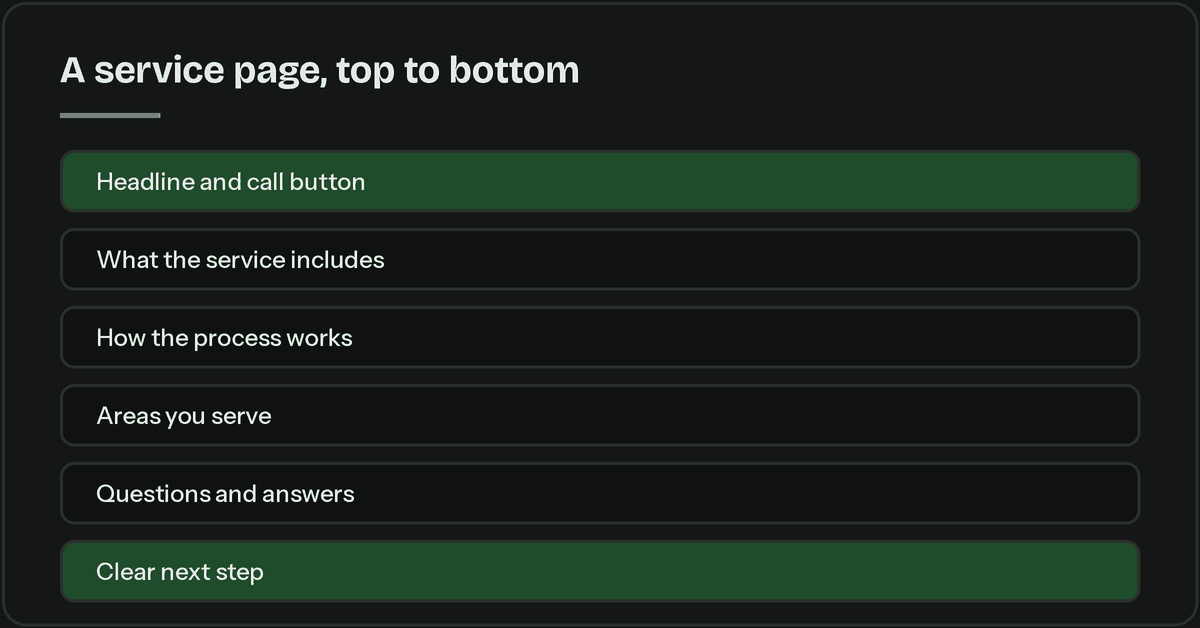
The structure, section by section
The top of the page
The first screen matters most. Include the following.
- A headline that names the service and the main area, such as Furnace Repair in Spokane.
- One or two sentences summarizing what you do and who it is for.
- A prominent phone number and a button to request a quote or book.
- A real photo of your team doing this kind of work.
A visitor should know within seconds that they are in the right place and how to reach you.
What the service includes
Explain what customers get. List the specific tasks or types of jobs covered. If you offer different levels of service, explain the difference. This section helps customers confirm you do what they need and gives search engines the detail they need to understand the page.
Signs you need this service
Describe the problems or situations that lead people to look for this service. Customers often search for symptoms before they search for a service, so this section connects with them earlier.
How the process works
Walk through what happens from first contact to finished job. A simple sequence, such as call, estimate, scheduling, the work itself and follow up, reduces uncertainty and makes it easier to say yes.
What affects the price
Even if you do not list prices, explain the factors that affect cost, such as size, materials, access or complexity. Customers appreciate the honesty, and it filters out poor fits before the first call.
Areas served
List the cities and neighborhoods where you offer this service. Keep it accurate and realistic. If you have area pages, link to them.
Why customers choose you
Explain what genuinely sets you apart, such as licensing, warranties, communication or experience with specific types of homes. Avoid vague claims. Use specific, verifiable details.
Real proof
Include photos of real projects and, where you have them, genuine reviews from customers who used this service, quoted accurately. Never invent testimonials or results.
Frequently asked questions
Answer the questions customers ask most about this service, each with its own heading and a direct answer. This section is also valuable for ChatGPT and Google answers tools, which often draw on clear question and answer content.
A final call to action
End with a clear next step and your phone number again. Someone who reads to the bottom is interested. Make it easy for them to act.
Writing tips
- Use plain language and short paragraphs.
- Write the way you explain the service to a customer in person.
- Use headings that describe each section clearly.
- Keep the page focused on one service.
- Use your main service phrase naturally, without repeating it awkwardly.
Technical basics
- A unique title tag naming the service, area and business.
- A meta description that summarizes the page for searchers.
- Descriptive alt text on photos.
- Fast loading, especially on phones.
- Internal links to related services and relevant blog posts.
- A tappable phone number.
Common mistakes
- One page covering every service.
- Copied text across several service pages.
- No pricing information at all, not even cost factors.
- Stock photos that look nothing like your business.
- Burying the phone number at the bottom.
- Generic claims like best quality without anything to back them up.
If you want service pages built to this standard, our web design services focus on pages that rank and convert for local service businesses. Our guide on why a website is not generating leads covers related problems worth checking.
Frequently asked questions
How long should a service page be?
Long enough to answer the questions customers have about that service. For many services, that means several sections, but every section should earn its place.
Should each service area get its own version of every service page?
Usually not. One strong page per service, plus genuinely local area pages for your main communities, avoids thin duplicate content.
Where should reviews go on a service page?
Near the sections where visitors are deciding, such as after the process or near the call to action. Use genuine reviews about that service where possible.
Next step
Want to know how your service pages compare with what customers need? Request a free audit and we will review your pages and suggest improvements.
Work with a local team: Spokane SEO, Spokane Valley SEO and a free SEO audit from an SEO company in Spokane.