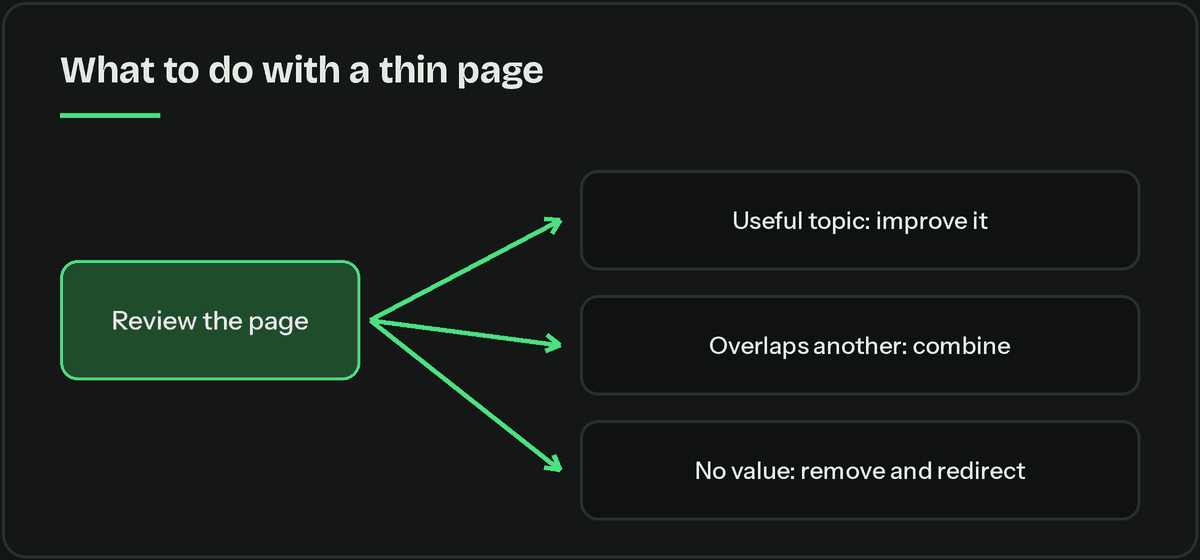
Short answer: Thin content is any page that offers little real value, such as a service page with two sentences, a location page that only swaps the city name, or a short blog post that repeats what others say. For each thin page, decide whether to improve it with genuinely useful information, combine it with a related page and redirect the old address, or remove it and redirect visitors to the most relevant remaining page.
Most business websites grow in bursts. A few pages at launch, a flurry of blog posts one year, some location pages another time, perhaps a page for a promotion that ended long ago. Years later, the site holds a mix of strong pages and pages nobody would miss. Those weaker pages are not just harmless clutter. They can make it harder for search engines to see the value in the rest of your site.
This guide explains how to find thin content and how to decide what to do with each page.
What counts as thin content
Thin content is not simply short content. A short page that fully answers a simple question is fine. Thin content is content that does not do its job. Common examples on local business sites include the following.
- Service pages with a heading, a sentence or two and a contact button.
- Location pages that are identical apart from the city name.
- Blog posts that cover a topic in a few generic paragraphs.
- Old announcements and promotions that no longer apply.
- Tag and category archives with only one or two posts.
- Several pages targeting almost the same topic with slightly different wording.
Why it matters
Search engines try to judge the overall usefulness of a site, not just individual pages. When a large share of pages are thin or duplicated, crawlers spend time on low value pages, and the site as a whole can look less helpful. Google’s guidance emphasizes content that is created to help people rather than to fill space. Cleaning up thin pages lets your best content stand out.
There is a visitor side too. Someone who lands on a thin page from a search result leaves disappointed, and that impression carries over to your business.
How to find thin pages
List your pages
Export a list of all published pages and posts from WordPress, or use your XML sitemap as a starting point.
Gather simple data
For each page, note a few facts from free tools.
- Clicks and impressions from the Search Console performance report.
- Visits and key events from Google Analytics.
- Whether the page is indexed, from the Search Console page indexing report.
- A rough word count and whether the content is unique.
Look for patterns
Pages with no clicks, no visits and little unique content are your first candidates. Groups of similar pages, such as many city pages with the same text, are another clear pattern.
Deciding what to do with each page
Improve it
Choose this when the topic matters to your business and customers search for it. A thin service page for a core service should almost always be improved, not removed. Add what customers need: what the service includes, how it works, what affects price, areas served and real answers to common questions.
Combine it
Choose this when several pages cover overlapping topics. Merge the best parts into one stronger page, then redirect the other addresses to it with permanent redirects. This often works well for clusters of short blog posts on the same subject.
Remove it
Choose this when the page has no value and no realistic way to become valuable, such as an expired promotion. Redirect the old address to the most relevant remaining page. If no page is relevant and the old page has no links or traffic, letting it return a not found status is acceptable.
Keep it out of search
Some pages need to stay for visitors but do not belong in search results, such as a thank you page. Use noindex for those.
Doing it safely
- Back up the site before removing or merging anything.
- Keep a spreadsheet of every change, including old and new addresses.
- Set up redirects at the same time you remove or merge pages.
- Fix internal links so they point directly to the new destinations.
- Remove deleted pages from your sitemap and resubmit it in Search Console.
- Watch Search Console for errors over the following weeks.
Our guide to content marketing for service businesses covers how to plan new content so it does not become thin later.
Location pages deserve special care
City pages are one of the most common sources of thin content on local business websites. Instead of many copied pages, consider fewer, stronger pages for the areas you serve most, each with genuinely local information such as the neighborhoods you cover, typical jobs in that area and relevant local considerations. Quality beats quantity here.
If you want a second opinion on which pages to keep, merge or retire, our SEO services include content audits for local businesses.
Frequently asked questions
Will deleting pages hurt our rankings?
Removing genuinely thin pages and redirecting them properly usually helps or has no negative effect. The risk comes from deleting pages that bring traffic or links without redirecting them.
Is there a minimum word count for a page?
No. What matters is whether the page fully answers what visitors need. Some topics need a few hundred words, others need much more.
How often should we review for thin content?
A review once a year is enough for most small business sites, plus a check after any big burst of new pages.
Next step
Want help deciding which pages on your site are pulling their weight? Request a free audit and we will flag thin and overlapping content and recommend what to do with it.
Work with a local team: Spokane SEO, Spokane Valley SEO and a free SEO audit from an SEO company in Spokane.