
Short answer: Topical authority means covering your services thoroughly enough that search engines and answer tools see your website as a reliable source on those topics. For a local business, that means a strong page for each core service, supporting content that answers the questions customers ask about it and clear internal links connecting them. Depth and accuracy matter more than volume. A small site that explains its services well can be more useful than a large site full of thin pages.
People talk about topical authority as if it were a score Google assigns. It is better understood as a description of what happens when a website covers a subject thoroughly and well. Search engines and answer tools look for sources that clearly understand a topic. When your site answers the full range of questions about your services, it becomes a more useful and more trustworthy source.
This guide explains how a local service business can build that depth without writing hundreds of pages.
What topical authority means in practice
Imagine two water heater companies. The first has a single services page listing water heater repair in a bullet point. The second has a dedicated page for water heater repair and replacement, plus articles explaining tankless versus tank options, signs a water heater is failing, how to flush a tank and what affects replacement cost. All of it is accurate, clearly written and linked together.
The second site gives search engines, answer tools and customers much more to understand. That is topical depth.
Why it matters for ChatGPT and Google answers
answer tools often answer questions by summarizing information from sources that clearly explain a subject. A site with thorough, organized coverage of a topic offers clear answers to many related questions. When someone asks an answer tool about a service in your area, a site that covers that service well has a better chance of informing the answer.
Build around your core services
Start with service pages
Each core service deserves its own page that explains what it involves, signs a customer needs it, your process, what affects price and the areas you serve. Our guide to web design for service businesses explains how service pages fit into a site.
List the questions customers ask
For each service, write down the questions customers ask before, during and after the job. These become supporting content ideas.
Group related content
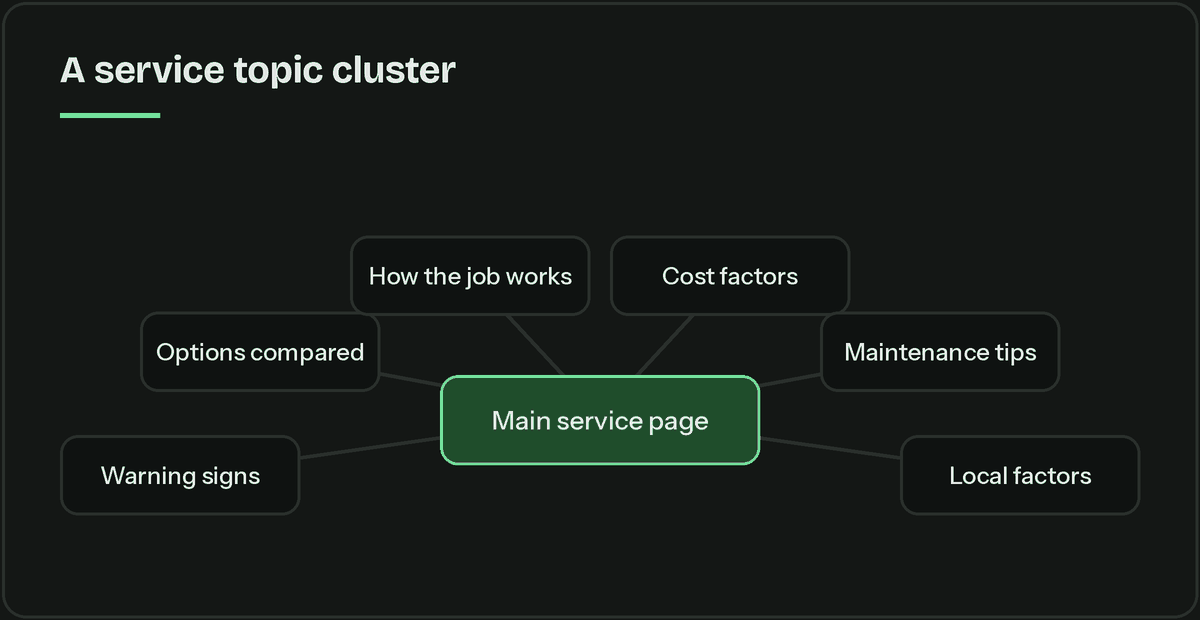
Organize content into clusters. Each cluster has a main service page and several supporting articles that link back to it.
Supporting content that adds depth
- How to tell if you need it: warning signs and symptoms.
- Options and comparisons: repair versus replace, material choices.
- Process explanations: what happens during the service.
- Cost factors: what affects price, without invented numbers.
- Maintenance and prevention: how customers can avoid problems.
- Local considerations: climate, building types or regulations in your area.
Depth, not volume
Avoid thin pages
Many short pages that say little can dilute your site. Our guide on improving or combining thin content explains how to handle them.
Avoid near duplicate pages
Writing the same article several times with slightly different wording does not add depth. It adds clutter.
Keep accuracy high
Depth only helps if the information is correct. Check facts and revise content when things change.
Connect content with internal links
Internal links show how your content fits together.
- Link from each supporting article to its main service page.
- Link from the service page to the most useful supporting articles.
- Link between related articles where it helps the reader.
- Use descriptive anchor text that says what the linked page covers.
Show experience
Content that reflects real experience is more valuable. Describe what you see on the job, common mistakes customers make and how you approach problems. Include real photos. Explain who writes or reviews the content and why they know the subject.
Stay focused
Topical authority is about relevance. A plumbing company writing about unrelated subjects does not build depth in plumbing. Stay close to the services you offer and the questions your customers ask.
Measure progress
Use Google Search Console to watch the range of queries your pages appear for. Growing coverage of related questions suggests your depth is improving. Track calls and inquiries from service pages too, since the goal is customers, not just impressions.
A practical starting point
Choose your most important service. Strengthen its main page first, then add three or four supporting articles that answer the questions you hear most often, link them together and review the results over a few months. Then repeat the process for your next service. Working one cluster at a time keeps the effort manageable and produces a site that is genuinely thorough where it matters most.
Our guide to content marketing for service businesses explains how to plan supporting content. If you want help building topic clusters around your services, our search answer optimization services include content planning focused on depth and accuracy.
Frequently asked questions
How many articles do we need for topical authority?
There is no set number. Cover the questions customers genuinely ask about each core service, clearly and accurately.
Can a small site have topical authority?
Yes. A focused site that explains a few services thoroughly can be more useful than a large site with shallow coverage.
Should we write about topics outside our services?
Generally, stay close to your services and customer questions. Unrelated content does little to build relevance.
Next step
Want to know where your site’s coverage is thin? Request a free audit and we will map your services against the questions customers ask.
Work with a local team: Spokane SEO, Spokane Valley SEO and a free SEO audit from an SEO company in Spokane.